Showing posts with label Scholarly. Show all posts

The Golden Age of Scholarship on Dance in South Indian Cinema is Here

Monday, February 3, 2020
Back in August of last year, as I emerged from a period of gripping ennui that had largely led to my blog hiatus, I eagerly went on an internet search jaunt to see what new finds might be out there, and I happened onto Hari Krishnan's just-published book, Celluloid Classicism: Early Tamil Cinema and the Making of Modern Bharatanatyam.  Within the blink of an eye I had ordered it, and I have slowly been reading it in earnest.

Reading through this masterful contribution has been riveting.  Every chapter is filled with one exciting piece of information after the other, populated with the names of people and films I've encountered over my years of trying to quench my thirst for knowledge of a topic that is little-researched, reclusive, and under-appreciated.

But the book is not simply a descriptive work that reveals anecdotes and tales from the past.  Having dug deep into archives, film print culture, personal collections, and a few candid interviews, Hari is out to explain the significance of the information, make connections, and contribute meaningful and new ideas to the world of scholarship on Indian dance and cinema and the real people and communities involved— the book is based on his doctoral dissertation, after all!

The central arguments of his book are something I've never heard anyone even hint before about Bharatanatyam.  As the back cover describes, "This book unsettles received histories of modern Bharatanatyam by arguing that cinema [...] bears heavily and irrevocably upon iterations of this 'classical' dance" and that there was a "reciprocal exchange of knowledge between screen and stage versions of Bharatanatyam in the early decades of the twentieth century."  That's quite tame frankly, given that by the time one has made it to the end of the book, the "exchange" and "heavy bearing" are clearly even more significant.

My Article "Screendance in Indian Cinema" and Thoughts on Film Dance

Saturday, May 31, 2014
Last week saw the end of the fourth Naada Bindu Festival—a three-day residential arts retreat at the Chinmaya Naada Bindu gurukul for Indian performing arts in Pune. The festival features a number of dance and music performances, lecture-demonstrations, and other activities. Ramaa Bharadvaj, whose "Reminiscences of a Disciple" personal article on Kamala I posted back in 2011, is the director for dance at the Chinmaya Naada Bindu and she "conceptualised, designed and edited" a journal for this year's festival titled Rasikatvam. I had the honor of being invited to write an article for the journal on the topic of classical dances in cinema culture, and I chose to write specifically about the advantages and distinct pleasures that screendance offers to audiences of Indian dance. My submitted article was edited somewhat and given a snazzy layout for the final printing. Images of the article are at the end of this post and it can be viewed in its entirety here.

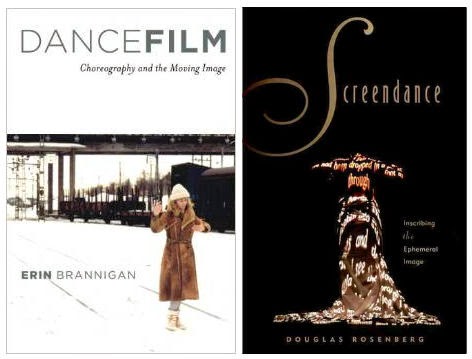
I wrote the article as a beginner to the topic of screendance, and as I read some published literature on the subject it became clear that the growing field is rich in thought-provoking theory with ample room for further analysis and scholarship. The sources I found the most exciting and comprehensive and would recommend to anyone interested in this subject are first Harmony Bench's review essay in Dance Research Journal, and then the two books that Bench reviewed: Screendance: Inscribing the Ephemeral Image by Douglas Rosenberg (especially chapters 1-3; brief Google Books preview) and Dancefilm: Choreography and the Moving Image by Erin Brannigan (previewable on Google Books).

Reading these sources has changed the way I view Indian dance as captured in cinema and by the camera, and a spark has been lit in my mind about the advantages and pleasures the format offers to Indian dance forms. I'm not sure that I really got to the heart of my excitement in my basic and dryly-written article, but it provides a basic overview of the advantages of Indian dance on film and some interesting food for thought.

A Conference Dedicated to Dance & Music in Early South Indian Cinema!

Sunday, July 14, 2013
I am completely astonished to learn that, only a month and a half ago, an international symposium/conference "Dance, Music, Politics and Gender in Early South Indian Cinema" was held in France with an exclusive focus on the  "representation of dance and music in early South Indian cinema from its beginnings in the second decade of the twentieth century until the 1950s."

But what raised the conference to the level of sheer awesomeness was that all the panel presentations but one focused on dance in early South Indian films, cinema halls, literature, or hereditary communities with a heavy emphasis on the depiction, participation, and history of the "hereditary communities of temple and court dancers and musicians" in South India and the reconstruction of the dance forms known today as Bharatanatyam and Kuchipudi.  When I first saw the conference title I thought Carnatic and Periya Melam music in film would be given a privileged position, but instead dance in film got to finally and deservedly bask in the limelight!  The conference was organized by dancer-scholar Tiziana Leucci and scholar Davesh Soneji in partnership with the Quai Branly museum (where Tiziana is a post-doctoral fellow) and the Centre for Studies in India and South Asia.

Crowning all this glory is undoubtedly the conference program which featured not only photos of a young Kamala on a Naam Iruvar poster but also screencaps of Sayee and Subbulakshmi from their dance "Neeli Magan" in the Tamil film Malaikkalan.  Seriously! Am I dreaming?!

Sayee Subbulakshmi! (source)
I found out about the conference while researching for my upcoming three-part post about the hereditary nattuvanar Muthuswami Pillai, the brilliant dancing duo Sayee and Subbulakshmi, and actresses/playback singers R. Padma and P.A. Periyanayaki.  As I strolled Google for more information about a film Muthuswami was said to choreograph for, Devadasi (Tamil, 1948), I happened onto an excellent review of the conference in Frontline magazine by participant Theodore Baskaran!  The more I read the wider my eyes got...I simply am excited beyond words that this narrow and niche subject is getting concentrated scholarly attention from knowledgeable scholars in the field.  I also see that Narthaki's recent newsletter included a link to Baskaran's article in the review section which gives information about the conference even further reach to interested dance enthusiasts!

Kalavantulu/Devadasi Dances in the films Muddu Bidda and Periyar (An Ode to Davesh Soneji's Latest Book)

Thursday, August 16, 2012
I've been posting a bit less frequently lately because I've been completely distracted by the discovery of a decent amount of fascinating scholarly research and writing on the subjects of the history of India's "classical" dance forms and "devadasi" women, the movements in the early to mid-twentieth century to "revive" these dance forms and mark traditional practitioners as degenerated and debased, and the history of early cinema and sound recording in South India. 

One of my favorites among the scholars writing on these subjects is Davesh Soneji whose most recent work has greatly inspired me and fueled the fire for this post.  Soneji has worked on two very fascinating compilations, first as the co-editor for Performing Pasts: Reinventing the Arts in Modern South India and second as the editor for Bharatanatyam: A Reader.  The former has some enlightening essays, and includes the excellent piece "Memory and the Recovery of Identity: Living Histories and the Kalavantulu of Coastal Andhra Pradesh" by Soneji himself that I linked to full-text in my post on devadasi-like dances in South Indian films.  The latter work I found particularly valuable in the way that it provides an excellent overview of the varied and complicated history of what we today call Bharatanatyam. 

But it's Soneji's latest work, Unfinished Gestures: Devadasis, Memory, and Modernity in South India (click the link to preview at Google Books), that astounded me by presenting perspectives and bits of information that I've hardly seen in most other scholarly writing on the subject. For this post, I initially wanted to simply present videos I tracked down of two "devadasi" film dances Soneji discusses in the book and highlight the intriguing details he unearths.  But it's flowered into a fuller, but still brief, overview of the "secular" aspects of devadasi dance in South India that Soneji highlights. Or rather, this post is basically a long string of quotes from Soneji's book because I cannot possibly say it better than he does. :)

For those that may not be as familiar with the history of "devadasis" in South India, I thought Soneji's overview was worth quoting in full:
"From the late sixteenth-century Nayaka period onward, devadasis have functioned as courtesans, secular dance artists organized in guilds called melams, and temple workers, some of whom performed in the public spaces of certain Hindu temples.  However, these communities have always occupied an ambiguous status in South Indian society.  On the one hand, devadasis possessed a degree of social agency in that they were not restricted by the norms of patrifocal kinship.  They lived in quasi-matrilineal communities, had nonconjugal sexual relations with upper-caste men, and were literate when most South Indian women were not.  On the other hand...courtesans were commodities regularly bought and sold through the intercession of the court.  In other contexts, as the concubines, mistresses, or "second wives" of South Indian elites, they were implicated in a larger world of servitude focused on the fulfillment of male desire.  Beginning in the mid-nineteenth century, vociferous social reform movements in South India aimed to dislodge communities of professional dancing women from their hereditary performance practices.  Over the next hundred years, their lifestyles were criminalized on the basis of their nonconjugal sexuality, which was understood as prostitution.  The Madras Devadasis (Prevention of Dedication) Act, implemented in 1947, officially outlawed the social, ritual, and aesthetic practices of these women." 

A Personal Article on Kamala, "Reminiscenses of a Disciple"

Monday, August 15, 2011
Kumari Kamala (Sruti Magazine)
A few months back I received a comment from Ramaa Bharadvaj (a Bharatanatyam and Kuchipudi exponent, classical dance school director/teacher, among many other things), who related that she had studied dance under Kamala in the 70s and toured with her.  To date I’ve dedicated many posts or parts of posts to Kamala and her wonderful film dances from various stages of her life ('baby kamala' dances, rare dances, more rare dances, Konjum Salangai dances, a recent performance and more) when she known as Baby Kamala, Kumari Kamala, Kamala Laksman/Laxman, and now Kamala Narayan or simply Kamala. What a delight to find someone who knew her personally in the flesh!

The Freedom Movement Through Tamil Cinema (Galatta Cinema Article)

Wednesday, June 30, 2010
Thanks to the fantastic two-part article "The Freedom Movement Through Tamil Cinema" by Randor Guy in the August and September 2007 issues of Galatta Cinema Magazine, I finally am able to identify the iconic image I've seen in various Indian films/artwork as Subramania Bharathiar (also known as Subramanya Bharathi), the cult rebel Tamil poet of India whose writings were banned by the British!  I first remember seeing his iconic image in the song "Konjum Mainakkale" from Kandukondain Kandukondain:


Powered by Blogger.
Back to Top